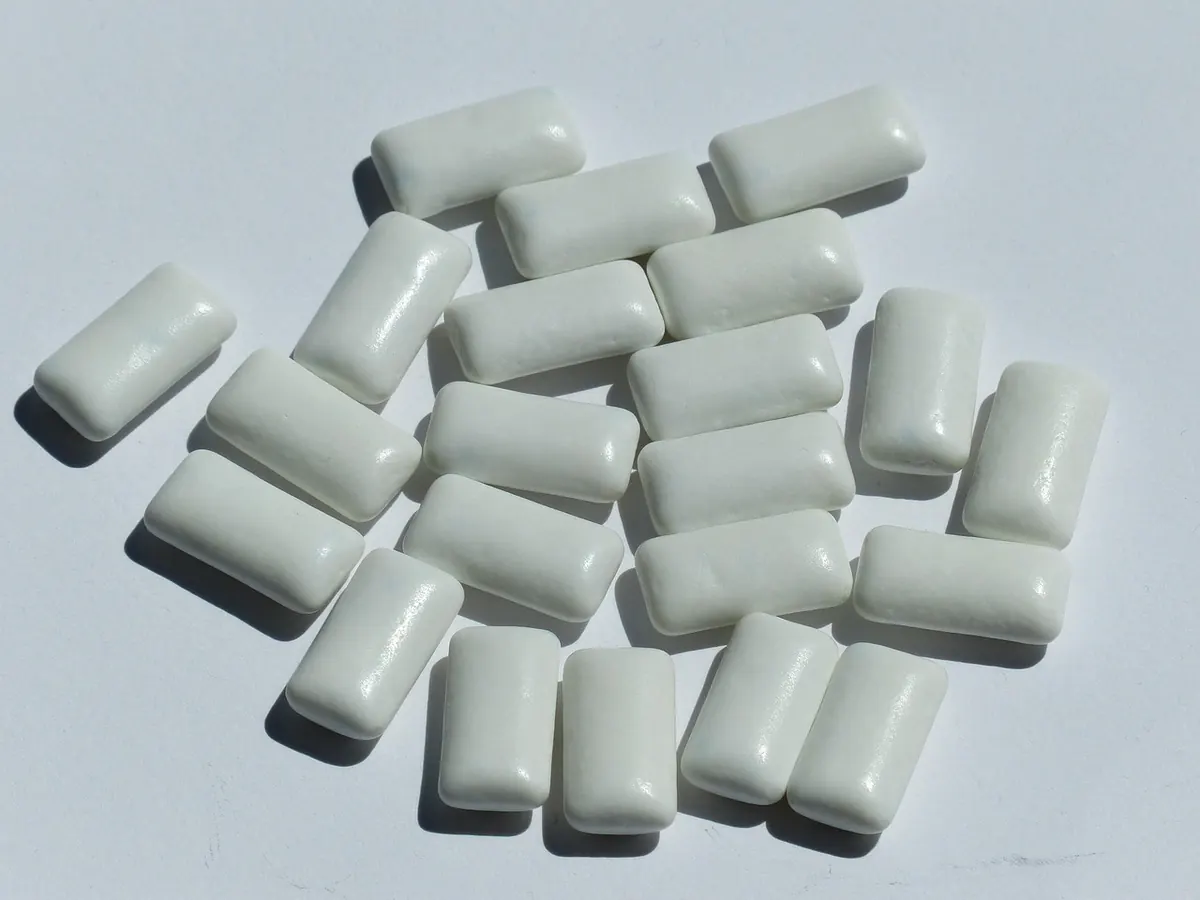
Turn over almost any packet of chewing gum and you will meet three words doing a lot of quiet work: gum base. It is the part that never dissolves, the reason the chew outlasts the flavour, and the ingredient most responsible for whether a gum feels soft, snappy or rubbery. If you have ever wondered why one brand turns to putty in two minutes while another keeps its bite to the end, the base is usually the answer.
This guide covers the two families of gum base, the supporting ingredients that shape texture, and the practical business of reading a label before you spend money on a pack you will not finish.
What "gum base" actually means
Gum base is the insoluble, elastic fraction of chewing gum. Everything else — sweeteners, flavours, acids, colours — is carried inside it. In a typical recipe it is the largest single ingredient by weight, though the exact proportion varies from brand to brand and between a soft stick and a hard coated pellet.
The awkward part for shoppers is that labelling rules allow the whole blend to be declared simply as "gum base" rather than broken down into its individual polymers, resins and waxes. That is why two packs can list an identical ingredient line and chew completely differently. You are not being kept in the dark deliberately; the base is a manufactured blend, and manufacturers treat the precise formula as commercially sensitive.
So a label tells you less than you might hope. It does, however, give clues — and the first thing to look for is whether any natural resins are named at all.
Natural bases: the original chew
The first chewing gums were made from tree exudates. Chicle, tapped from the sapodilla tree in Central America, is the best known; jelutong, sorva and massaranduba played similar roles. These resins are collected much like rubber latex, then cleaned and softened before being blended with sugar and flavour.
Natural bases tend to feel softer and warmer from the first chew. They also warm up quickly in the mouth, which is pleasant at first but can lead to a chew that flattens or goes slightly grainy after a while. Supply, cost and consistency pushed most large manufacturers towards synthetics in the mid-twentieth century, and chicle became a niche ingredient.
It is worth being precise about the word "natural" on a pack. It might mean the base itself is plant-derived, or it might refer only to the flavourings or the sweetener. If the base matters to you, look for named resins such as chicle rather than a general claim on the front of the packet.
Synthetic bases: how modern gum got its bounce
Most gum on UK shelves uses a synthetic base. The usual building blocks are polymers such as butadiene-styrene rubber, polyisobutylene, isobutylene-isoprene copolymer and polyvinyl acetate, combined with resins that adjust tack and chew. Polyvinyl acetate in particular behaves a little like a texture dial: more of it, and the gum holds its structure for longer; less, and it softens faster.
The appeal is predictability. A synthetic base can be engineered to stay chewy for twenty minutes, to blow into a bubble without tearing, or to release flavour steadily rather than all at once. It is also cheaper and more reliable to source than tree resin, which is why sugar-free and functional gums — the ones with whitening claims or added vitamins — almost always use it.
The supporting cast: what the other names do
Base alone would be unpleasantly tough, so it is always blended with a small group of helpers. Recognising them makes label reading much easier.
- Softeners and humectants — glycerin, lecithin and vegetable oils keep the base pliable so it does not crack or crumble as you chew.
- Fillers — calcium carbonate and talc add bulk, firm up the texture and reduce cost.
- Waxes — carnauba, beeswax and microcrystalline wax give coated pellets their crisp first bite and glossy finish.
- Antioxidants — tocopherols or similar protect the base from turning stale in the packet.
- Bulk sweeteners — sorbitol, xylitol, maltitol and mannitol provide the volume that sugar once did in sugar-free recipes.
- Intense sweeteners — aspartame, sucralose, acesulfame K or stevia supply the sweetness itself in small amounts.
- Acids and flavours — citric and malic acid for sourness, plus natural or nature-identical flavourings.
- Coatings — a xylitol or sorbitol shell, sometimes polished with wax, which affects both crunch and how quickly sweetness arrives.
If you are watching your intake of polyols because of digestive sensitivity, note that they are widely used in sugar-free gum and can have a laxative effect in larger amounts. Keep portions modest and speak to a pharmacist or dietitian if you are unsure.
Texture: why one pack feels soft and another snaps
Texture is a balancing act between the base, the softeners and the coating. A soft stick usually has more softener and a lower proportion of stiff polymer; a hard coated pellet has more polymer, more filler and a thick shell that cracks before the chew begins. Bubble gum sits somewhere apart, built with a more elastic base so it stretches rather than tears.
A simple test when you are trying something new: notice the first bite, then notice the chew after ten minutes. If it turns dry and cardboardy, the base-to-softener balance is off for your taste. If it collapses into a soft lump, there is likely more softener than you enjoy. Neither is a fault — it is just a different design.
Biodegradability and disposal
The reason gum sticks to pavements is the same reason it lasts so long in your mouth: the polymers in a synthetic base resist breakdown. Natural resin bases are more readily broken down by microbes, but "more readily" is not the same as quickly, and it depends on where the gum ends up. A chicle-based gum on a kerb is exposed to weather and bacteria; the same gum sealed in a bin liner in landfill is not.
Claims of "biodegradable" gum are worth reading closely. Ask what part is biodegradable and what standard has been used to test it, because the base may be only one component of the finished product. As a habit, wrap spent gum in its own wrapper and put it in a bin, and keep packs out of hot cars and sunny windowsills, where the base softens and pellets turn sticky.
How to choose a pack in the shop
You do not need a chemistry degree to make a good decision. A short routine will do.
- Read the ingredient line and find the base. If it says only "gum base", you will need to judge by texture and price rather than ingredients.
- Look for named natural resins if you want a softer, more traditional chew — and expect it to tire faster.
- Check the sweetener system, especially if you avoid polyols or specific intense sweeteners.
- Note the coating and waxes; a thick shell means a crunchier start and slower sweetness.
- Buy the smallest pack first. Chew one piece, then another after ten minutes, and see how it holds up.
- Store it cool and dry, sealed, and away from strong smells — gum base picks up odours from whatever is next to it in a bag.
Once you know that "gum base" is a blend rather than a single substance, the shelf stops looking uniform. Two packs with near-identical labels can deliver a soft, quick-fading chew or a firm one that lasts half an hour, and the difference is almost entirely in that unnamed base. Taste two side by side, take notes, and you will quickly work out which kind of chew suits you.
Photo: Hans / Pixabay